Carbon or Argon, and what changes on Dec 1
The short version
Gemini 4 API prices double on Dec 1, and Gemini 4 Carbon is the model that spends the most tokens.
Carbon and Argon share one per-token price ($2 input and $10 output per 1M tokens through Nov 30, 2026, then $4 and $20), so the real cost gap is how long each one thinks.
Pick Carbon’s jobs before the bill doubles, and clean up old request code first, since sampling settings are now ignored and explicit caching is gone.
Gemini 4 API prices double on Dec 1, and Gemini 4 Carbon is the model that spends the most tokens.
Google opened Carbon to paying developers and enterprises on Nov 10, 2026, is rolling it out to Google AI Ultra subscribers, and calls it its strongest model, built for long agent runs in coding, knowledge work, science and cybersecurity (Google: Gemini 4 Carbon is now available).
It costs the same per token as Gemini 4 Argon. What differs is how many tokens it burns per turn, which makes the choice between the two a routing and budget decision more than a quality one.
1. What shipped, and who can use it
The model id is gemini-4-carbon. Its default thinking_ is medium, with low and high as the other settings.
Through the Gemini API, input, thinking and output share one 1,048,576-token window, and a single response can run past 64K tokens with long decode (Google AI Studio: What’s new in Gemini 4 Carbon).
Carbon sits behind a paid plan on every standard route. Google lists these ways in (Google: Gemini 4 Carbon is now available):
- The paid tier of the Gemini API, in Google AI Studio and Android Studio. It is not on the Free tier (Google AI Studio: Gemini Developer API pricing).
- Gemini for business, through the API or the model drop-down, plus Google Antigravity and CodeMender.
- Google AI Ultra subscribers, in Google Antigravity, AI Studio, the Gemini app and AI Mode in Search.
- Copilot Pro+, Max, Business and Enterprise users in GitHub Copilot, billed at provider list pricing under usage-based billing, with a gradual rollout (GitHub Changelog: Gemini 4 Carbon in GitHub Copilot).
Two application routes sit outside those plans. Scientists can apply for six months of Argon and Carbon in Antigravity’s highest usage tier at no charge, subject to eligibility, capacity and selection. Cybersecurity defenders can apply to the Fairwind Program for Carbon for cyber.
That program got Carbon two weeks before the wider launch.
2. Carbon or Argon
Google is blunt about the default. Argon stays the pick for most work, and Carbon is for the jobs that push a model to its limit.
“Argon remains the ideal choice for the majority of software engineering and knowledge work” Google
The developer guide splits the jobs this way (Google AI Studio: Gemini 4 Carbon developer guide).
| Reach for | Google’s examples |
|---|---|
Gemini 4 Carbon (gemini-4-carbon) |
Hardest multi-step software engineering, architectural design and code auditing, formal math and scientific discovery, high-precision financial or legal synthesis, vulnerability research |
Gemini 4 Argon (gemini-4-argon) |
Interactive coding, day-to-day feature work, fast production loops, most advanced engineering and knowledge work |
| Both together | Carbon for upfront architecture, coordination and final verification, with Argon or Gemini 3.8 Flash for parallel implementation slices |
The trade-off is spelled out in the API docs. Carbon spends more thinking tokens per turn to explore and verify, which raises per-turn token use and latency compared with Argon.
Argon gives faster responses and lower token spend per turn (Google AI Studio: What’s new in Gemini 4 Carbon).
Inside Carbon, thinking_ is the main dial. Google suggests low for simple or cost-sensitive work, medium for most tasks including complex code and agent use, and high for hard math, science and the toughest code.
Its advice is to run your evaluations at all three levels and keep the lowest one that meets your bar.
3. What Google’s numbers say
Every figure below is Google’s own claim, from its launch post (Google: Gemini 4 Carbon is now available).
- Google says Carbon ranks #1 on CursorBench 4.0, Perplexity’s WANDR and Zapier’s AutomationBench, at more than 2X lower cost per task than the next best external model.
- On the new Multimodal Knowledge Agent benchmark, built with Artificial Analysis, Google says Carbon ranks #2 at more than 6X lower average cost per task than the top model.
- In Google’s Project Fortify system, Google says Carbon hit 100% recall on scanning and 95% precision on triage, on an internal benchmark. On open-source repository testing, Google reports an over 25% relative improvement on Argon’s recall rate.
- On Google’s 375-task agentic honesty benchmark, Google says Carbon passed 92% of tasks, against 70% for Argon.
The launch demos are Google’s too. Google says a team of Carbon agents using Antigravity’s /swarm built an open-world 3D game of its Mountain View campus, coordinating subagents to model 3D assets in Blender and build the browser game in Three.js. The post links a live version.

Google also published safety numbers next to the capability claims. It says Carbon blocked 99% of attack trajectories from its adaptive red-teaming agent in simulated cyberattack testing, and that the per-attempt breach rate fell to 0.8%, down from 3.1% on Argon.
Its chart of misalignment measures puts Carbon below Argon on all three panels it shows. The chart cites Google DeepMind’s methodology page, and the launch post links the full Gemini 4 Carbon safety and security report.
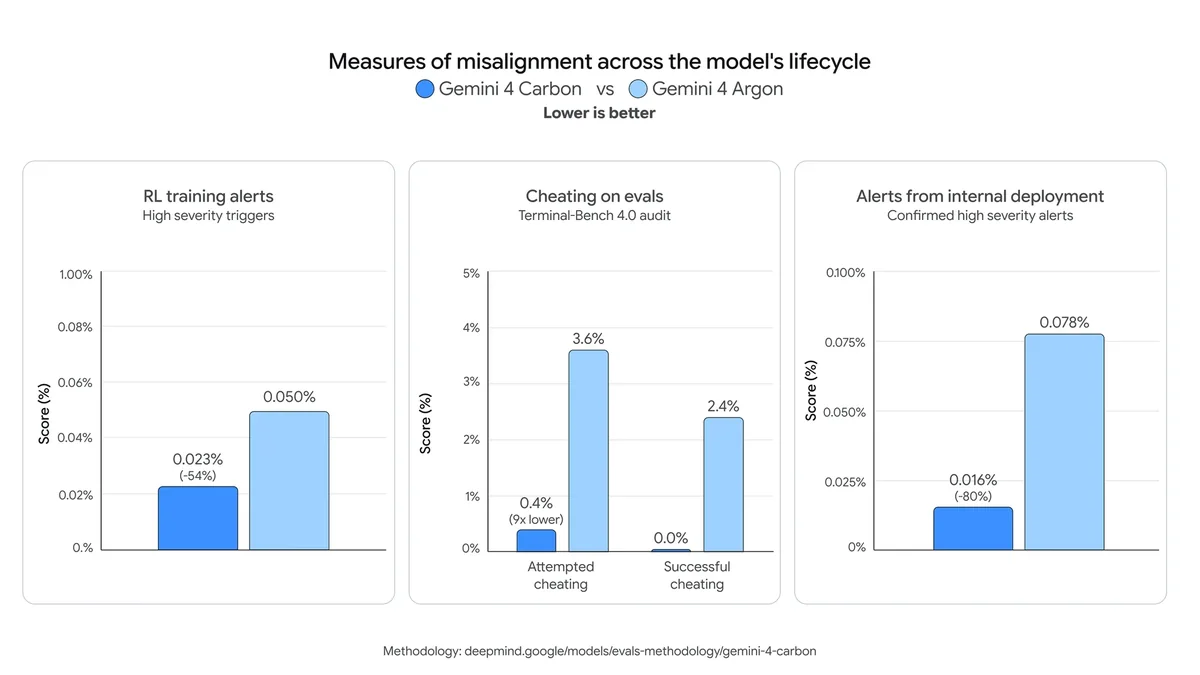
None of this is an independent measurement. Treat the rankings as Google’s reasons to run your own evals, not as a result for your workload.
4. What changes on Dec 1
Carbon and Argon are on the same introductory price, and the same price after it. On the paid tier of the Gemini API, per 1M tokens (Google AI Studio: Gemini Developer API pricing).
| Through Nov 30, 2026 | Starting Dec 1, 2026 | |
|---|---|---|
| Input | $2.00 | $4.00 |
| Output, including thinking tokens | $10.00 | $20.00 |
| Cached input (implicit caching only) | $0.10 | $0.20 |
Google’s launch post adds that the $4 and $20 price applies to the Carbon model intended for public access. GitHub bills Carbon in Copilot at provider list pricing, so check GitHub’s Models and pricing page after Dec 1 too.
Two billing details matter more for Carbon than for Argon. Thinking tokens are billed as output, and Carbon thinks longer by design.
Google also says every token the model processes is counted, including internal tool system instructions and function declarations when you use grounding, and Grounding with Google Search is still billed per query (Google AI Studio: What’s new in Gemini 4 Carbon).
So the token gap between the two models doesn’t change on Dec 1, but every extra token costs twice as much. If a hard job’s extra thinking on Carbon pays for itself at $10 per 1M output tokens, check that it still does at $20.
Until Nov 30 you can run that comparison on your own tasks at half the later rate.
5. One string to switch, five things to clean up
Coming from Argon, the switch is a drop-in. Change gemini-4-argon to gemini-4-carbon and the request schema stays the same.
Google’s two notes are to keep thinking_ at medium unless a job needs high, and to make sure your max_ and HTTP timeouts leave room for longer reasoning (Google AI Studio: What’s new in Gemini 4 Carbon).
Coming from Gemini 3 or earlier, old request code changes behavior quietly. Google’s developer guide and migration checklist list these (Google AI Studio: Gemini 4 Carbon developer guide; Google AI Studio: What’s new in Gemini 4 Carbon):
- Sampling settings are ignored. Custom
temperature,top_pandtop_kvalues are ignored and return a deprecation warning, so remove them. thinking_is deprecated. It returns a warning, so replace it withbudget thinking_.level - Explicit caching is gone. Remove calls that create or pass
cached_. Implicit caching is on by default for prompts of at least 4,096 tokens, at 95% off cached input.content - Timeouts need to grow. Hard prompts can take several minutes. Use
background=Trueon the Interactions API, or set your HTTP client timeout to at least 15 to 20 minutes. - The output cap is 64K by default. Requests default to 65,536 output tokens. To go further, set
background=Trueand raisemax_above 65,536. Google recommends at least 32,768 if you set a lower limit today, because Carbon can spend more of the limit on thinking.output_ tokens
One more trap with long outputs. If you set background to true without a max_ value, the server still stops after 64K tokens (Google AI Studio: What’s new in Gemini 4 Carbon).
Carbon also runs as the model behind the Antigravity agent in Gemini Managed Agents (antigravity-preview-09-2026), set through agent_config.
6. Carbon as the lead of a swarm
Google’s suggested way to use Carbon is as the deep thinker in a team of lighter, faster models.
Google Antigravity’s new /swarm command, in preview, turns your conversation into a coordinator that splits a task, adds named workers that run in parallel, and usually adds a verifier that reads the diffs and runs the tests.
Everyone posts to one shared message board, and idle members wait without using tokens (Google Antigravity Docs: Swarm).
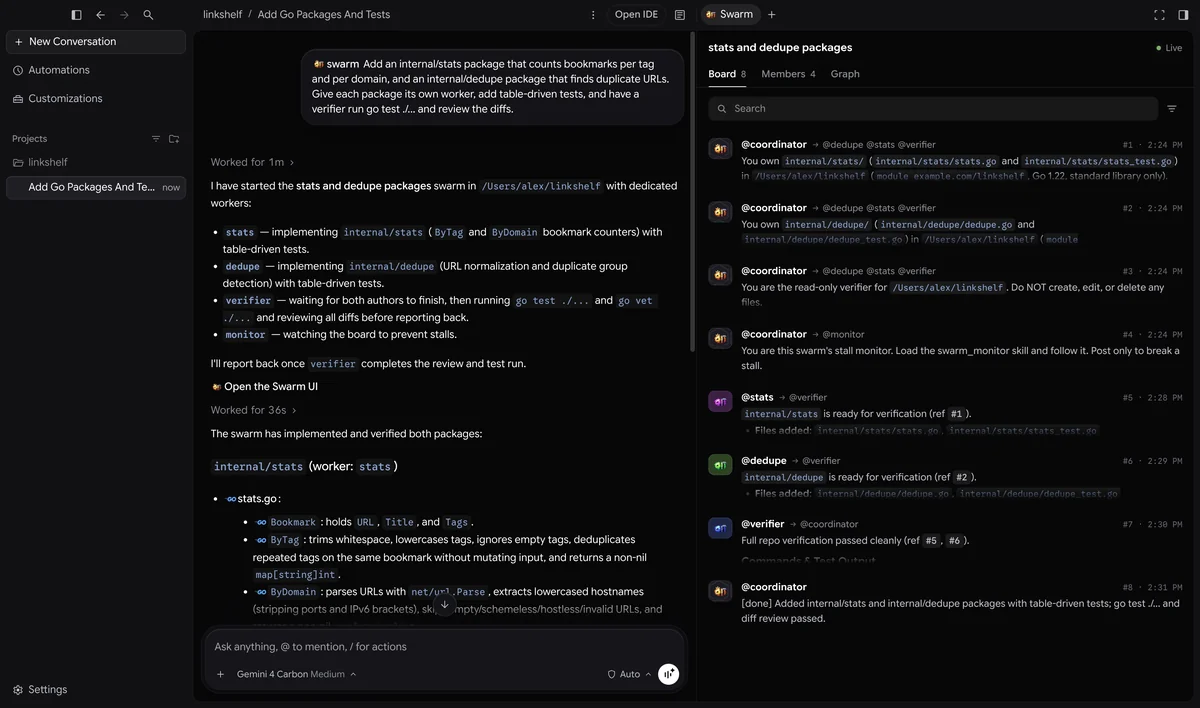
The Antigravity team suggests putting Carbon in the coordinator, architecture, security-audit and verifier roles, while lighter, faster models handle parallel file edits (Google Antigravity Blog: Gemini 4 Carbon and /swarm). Workers run on your conversation’s model unless your prompt asks for a different one.
Workers share your workspace by default, and the coordinator can give each one its own working copy when several edit at once.
Two limits apply. The docs list /swarm on Google AI Pro and Google AI Ultra plans in the Antigravity App and CLI, but Carbon itself is in Antigravity for Ultra subscribers.
And Google warns that every worker is its own agent, so a swarm uses quota much faster than a single conversation.
7. Who should recheck what
| If you… | What changed | What to check |
|---|---|---|
| Run Argon or Carbon on the Gemini API | Input, output and cached-input prices double on Dec 1, 2026 | Your monthly budget and alerts at $4 and $20 per 1M tokens |
| Migrate from Gemini 3 or earlier | temperature, top_p and top_k are ignored and thinking_ is deprecated |
Any code that relied on sampling settings for output style |
| Use explicit context caching | Not supported on Carbon | Remove cached_ calls and lean on implicit caching |
| Set short HTTP timeouts | Hard prompts can take several minutes | Raise to at least 15 to 20 minutes or use background=True |
| Hardcode a 64K output limit | Long decode can go past it, but only with background=True and a higher max_ |
Where your parser assumes one output step |
| Pick models in Copilot | Carbon bills at provider list pricing | Whether it should be your default, and the admin model policy |
Try /swarm |
Preview, and quota-heavy | Which roles get Carbon and which get lighter models |
Try this next
Try this
- Pick one task where Argon still falls short, such as a multi-file root cause or a code audit.
- Run it on
gemini-4-carbonatmedium, then athigh, and compare against Argon. - Before you switch, strip
temperature,top_p,top_k,thinking_and explicit caching from the request.budget - Raise client timeouts, or move long jobs to
background=True. - Price the winning setup at $4 and $20 per 1M tokens, the rate from Dec 1.
The model change itself is one line.
model="gemini-4-carbon"
Chef’s pick: keep Argon as the default and give Carbon only the jobs where your own evals show the extra thinking earns its keep, measured before Dec 1 and priced at the rate after it.