When Opus isn’t enough, Claude Fable 5.2 is the next step up
The short version
Claude Fable 5.2 is the model Anthropic wants you to reach for when Opus 5.5 still isn’t enough.
It shipped on Nov 9, 2026, costs less than Fable 5.1, and generates outputs up to 30% faster, with an optional fast mode on some platforms.
Four API changes can turn a request that used to work into a 400 error, so don’t just swap the model id.
Claude Fable 5.2 is the model Anthropic wants you to reach for when Opus 5.5 still isn’t enough.
It went generally available on Nov 9, 2026, as claude-fable-5-2 on the Claude API, with the same underlying model also shipping as Claude Mythos 5.2 for organizations in Anthropic’s verification programs (Anthropic: Introducing Claude Fable 5.2 and Claude Mythos 5.2; Claude docs: Fable 5.2 overview).
Everyday coding and knowledge work still starts with Opus 5.5. Fable is the step up for long, open-ended jobs those evals still miss.
1. What shipped, and what it costs
The public model is built for demanding reasoning and long-horizon agent work. The docs point to agent sessions that run for hours, multistep research, and analysis carried through to a finished document, spreadsheet, or deck (Claude docs: Fable 5.2 overview).
One engineer’s empty-folder prompt produced a prototype operating system that, Anthropic says, booted after eight days and more than 1,000 subagents, with windows, a login screen, and built-in Claude functionality (Anthropic: Introducing Claude Fable 5.2 and Claude Mythos 5.2).

Fable 5.2 and Mythos 5.2 share a 1M-token context window, up to 128K output tokens, and a Jun 2026 knowledge cutoff. Adaptive thinking is always on, steered by effort, and the API default is high.
Anthropic says it will not retire the model sooner than Nov 9, 2027 (Claude docs: What’s new in Claude Fable 5.2).
Standard price is $8 per million input tokens and $40 per million output tokens, down from $10 and $50 on Fable 5.1.
Cache writes are $10 (5-minute) and $16 (1-hour) per million tokens, cache reads are $0.20, and the Batch API is half the input and output price. Fast mode, where it is offered, is $16 and $80 (Claude docs: What’s new in Claude Fable 5.2).
The model id is claude-fable-5-2 on the Claude API, Claude Platform on AWS, Claude Models on Google Cloud (Anthropic managed and Google managed), and Microsoft Foundry, and anthropic. on Amazon Bedrock. Anthropic also says it is on all paid Claude plans (@claudeai on X, Nov 9, 2026).
Both models require 30-day data retention and are Covered Models. Zero data retention is only available when Anthropic expressly authorizes it (Anthropic: Introducing Claude Fable 5.2 and Claude Mythos 5.2).
2. When to leave Opus 5.5
Anthropic’s own advice is unusually plain. Start with the latest Opus model. Move to Fable 5.2 when your evals on Opus, even at higher effort, still don’t meet the bar (Claude docs: What’s new in Claude Fable 5.2).
“For most coding and knowledge tasks, we recommend that users start with Claude Opus 5.5, our strongest daily driver, and then switch to a different model as required” Anthropic
Fable can also sit above that daily driver in two documented roles. Other models can consult it as an Advisor on harder problems, and it can orchestrate smaller models on simpler tasks (Anthropic: Introducing Claude Fable 5.2 and Claude Mythos 5.2).
3. What Anthropic’s numbers say
The announcement table compares Fable 5.2 with Fable 5.1, Opus 5.5, GPT-6 Astra, and Gemini 4 Carbon.
Scores use each model’s highest available effort unless noted, and Fable and Opus scores are with safeguards on unless noted. Methodology is in the system card. Treat every figure as Anthropic’s own measurement.
A few of the gaps it highlights (Anthropic: Introducing Claude Fable 5.2 and Claude Mythos 5.2):
- FrontierCode 2.0, Xhigh effort: 49.1% for Fable 5.2, vs. 45.5% for Opus 5.5 and 32.4% for Fable 5.1. At High effort, Anthropic says Fable 5.2 scored about level with Opus 5.5 at Max effort (45.3% vs. 45.5%) for roughly half the cost per task.
- Terminal-Bench-Science 0.1: 74.6% for Fable 5.2 and 75.3% for Mythos 5.2, vs. 58.7% for Opus 5.5.
- Humanity’s Last Exam with tools: 74.2% vs. 67.7% for Opus 5.5. At Low effort, Anthropic says Fable 5.2 matched Opus 5.5’s top score for less than one-tenth of the cost per task.
- Remote Labor Index, High effort: 41.3% vs. 21.3% for Opus 5.5.
- RoboDojo Sim, Max effort (internal run): 64.9% vs. 39.4% for Opus 5.5.
It is not ahead everywhere. AutomationBench trails Gemini 4 Carbon (51.4% vs. 53.9%), and on AA-Briefcase 1.1 the Elo score trails Opus 5.5 (1785 vs. 1800) even though the rubric score is higher.
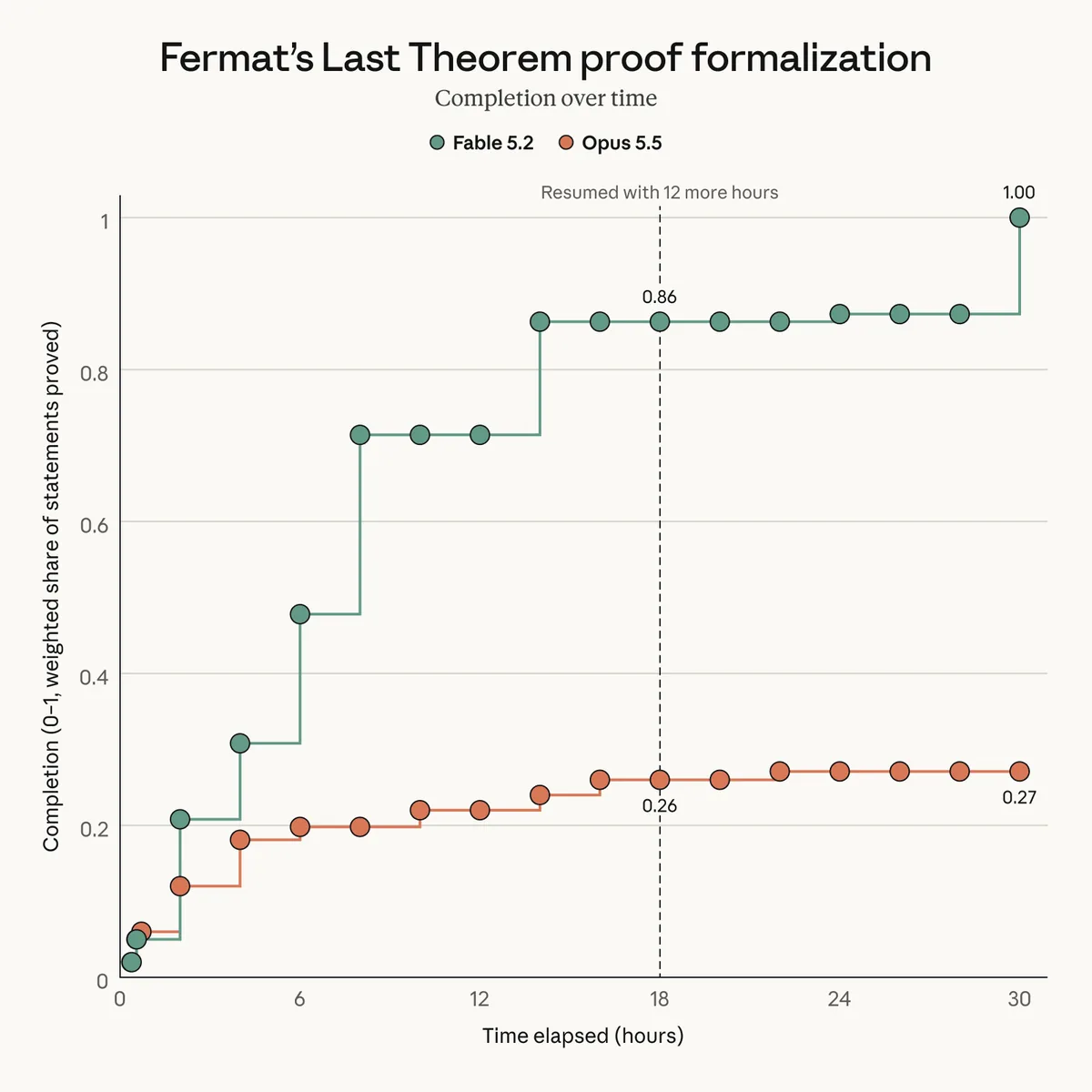
The official example that makes the gap visible is formalization. Anthropic says a team of about 1,000 Fable 5.2 agents fully formalized the proof of Fermat’s Last Theorem in Lean in 30 hours.
With the same setup, Opus 5.5 completed only 26% in 18 hours and finished at 27% after 30 (@claudeai on X, Nov 9, 2026).
The other prerelease examples are also Anthropic’s, not ours. An earlier Fable 5.2 run migrated a production service from Python to Rust that now starts about 26 times faster.
A one-paragraph prompt produced three working devices (a voice-assistant hub, a USB speakerphone, and a handheld virtual pet) whose boards were ready in under a day.
Anthropic also says Fable 5.2 completed two open problems in theoretical physics, both about black holes, with preprints linked from the announcement, and that Mythos 5.2 accurately modeled 28 of 34 virus capsid structures it attempted.

Compared with earlier Claude models, Fable 5.2 also shows substantially improved skills in controlling physical robots. Anthropic’s announcement video shows robots it controlled completing tasks such as solving a puzzle cube (Anthropic: Introducing Claude Fable 5.2 and Claude Mythos 5.2).

4. Fast mode and effort
Anthropic says Fable 5.2 and Mythos 5.2 generate outputs up to 30% faster than 5.1 at the standard price. Optional fast mode speeds token generation by up to 2.5 times, at $16 / $80. On the Claude API you set speed: "fast" on the request, with no beta header.
It is also documented on Claude Code, Claude Models on Google Cloud, and Microsoft Foundry for Anthropic-hosted deployments (as claude-fable-5-2-fast). Mythos fast mode is limited to verification-program organizations (Anthropic: Introducing Claude Fable 5.2 and Claude Mythos 5.2).
Effort has five levels: low, medium, high, xhigh, and max. Anthropic’s guidance is to start at high, step up to xhigh only where you have measured a gain, and reserve max for the ceiling.
Prompt lines that ask the model to skip thinking do not stop it at medium and above, so lower effort if easy requests get slow or expensive (Claude docs: What’s new in Claude Fable 5.2).
5. Four changes that can break your code
A model-id swap is not a drop-in if your client builds its own requests. Four changes from Fable 5.1 can return a 400 error (Claude docs: What’s new in Claude Fable 5.2):
- The prefix check now applies to every account. If you edit the
systemprompt,tools, or an earlier message and then send back a Fable 5.2 thinking block, the request fails. On Fable 5.1 this only errored by default on accounts created on or after Aug 31, 2026. Claude Code, claude.ai, Claude Managed Agents, and the Claude Agent SDK are not affected if they build the request for you. - Only Fable 5.2 and Mythos 5.2 read Fable 5.2 thinking blocks. Moving onto Fable 5.2 from Opus 5.5 keeps the earlier reasoning on the Claude API and Google-managed Claude Models. Moving the other way, including back to Opus 5.5, drops those blocks. The request still succeeds, and dropped blocks are not billed.
- Computer use goes through the
computer_toolset. The earliertoolset_ 20260801 computer_tool returns a 400 error on every platform except Amazon Bedrock.20251124 - With the advisor tool (beta), a Fable 5.2 executor accepts only Fable 5.2 or Mythos 5.2 as its advisor. Any other advisor, including Fable 5.1, returns a 400 error.
Adaptive thinking cannot be turned off, and forced tool use returns a 400. Thinking blocks also work only in the account that produced them, or a linked account.
6. Fable, Mythos, and the launch offer
Fable and Mythos are the same underlying model. Fable adds cybersecurity and biology safeguards so it can be sold to all users. When a classifier blocks a request, users get a response from Opus 4.8 for cybersecurity or Opus 5 for biology.
Anthropic says early testing showed about 55% fewer blocks than Fable 5.1, with safeguards it describes as equally robust (Anthropic: Introducing Claude Fable 5.2 and Claude Mythos 5.2).
Mythos 5.2 (claude-mythos-5-2, or anthropic. on Bedrock) keeps the full cyber and biology capabilities and is limited to organizations verified through the Life Sciences and Cyber Verification Programs. Claude Enterprise customers can also use Claude Security, which now includes Mythos 5.2.
The safety testing, including external evaluations, is summarized in the system card.
Eligible paid plans get extra Fable usage to mark the launch. Pro plans and standard Team seats get all Fable models included for one week (up to 50% of weekly usage limits) plus one Fable reset.
Max and Ultra plans, premium Team seats, and premium seats on legacy seat-based Enterprise plans get one to three Fable resets, based on how long they have subscribed. The offers started on Nov 9, 2026.
Resets go only to accounts that already had paid billing in place before Nov 9, 2026 at 1:00 p.m. ET, and they are not available on Claude’s unpaid plan or on several Enterprise billing types (Claude Help Center: Claude Fable 5.2 launch offers).
7. Who should recheck what
| If you… | What changed | What to check |
|---|---|---|
| Call the Messages API with your own client | Prefix check now fails on every account if you edit earlier turns | Whether your code keeps system, tools, and earlier messages append-only |
| Route or fall back between models | Only Fable 5.2 and Mythos 5.2 read Fable 5.2 thinking blocks | Expect those blocks to drop if the next turn is Opus 5.5 or Fable 5.1 |
| Use computer use outside Amazon Bedrock | computer_ now returns a 400 |
Switch to computer_ |
| Use the advisor tool with a Fable 5.2 executor | The advisor must also be Fable 5.2 or Mythos 5.2 | Set the advisor model in the same change, in a new conversation |
| Are on a paid Claude plan | One week of Fable plus one reset on Pro and standard Team seats, or one to three resets on Max, Ultra, and premium seats | Whether your billing was in place before Nov 9, 2026 at 1:00 p.m. ET |
| Need zero data retention | 30-day retention is required unless Anthropic authorizes an exception | Talk to your account team before you move production traffic |
Try this next
Try this
- Keep Opus 5.5 as the daily driver unless a hard eval still fails at higher effort.
- Start a new conversation on that job with
claude-fable-5-2, athigheffort. - If your own code builds the request, confirm it only appends messages and never edits
system,tools, or earlier turns. - If you use computer use outside Amazon Bedrock, declare
computer_instead oftoolset_ 20260801 computer_.20251124
To change the model id in a Messages API request, the migration guide uses this form.
model = "claude-fable-5-2"
Chef’s pick: start with a new conversation on a job Opus 5.5 still fails, at high effort, after you have checked the four breaking changes. Turn on fast mode only when the extra speed is worth double the token price.